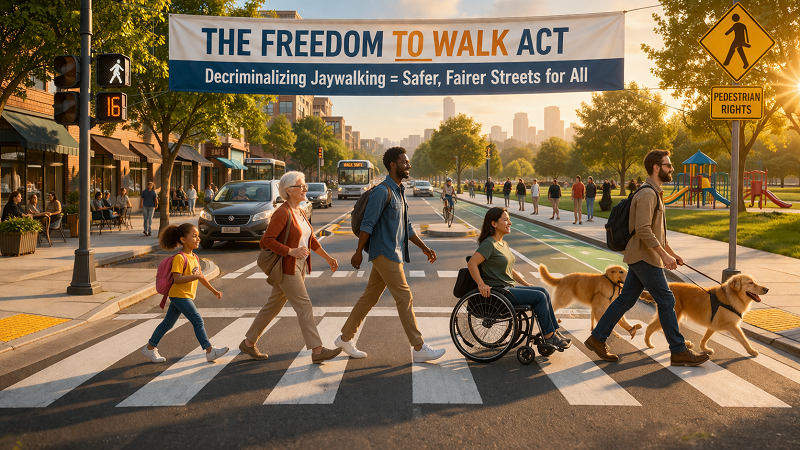
Walking is one of the most natural activities humans engage in every day. Yet in many cities, the simple act of crossing the street at the “wrong” moment or location has long been treated as a violation. That mindset is finally evolving, thanks to forward-thinking reforms like the Freedom to Walk Act. This law represents a meaningful shift in how society interprets pedestrian behavior: moving away from policing people on foot and toward protecting them instead. Decriminalizing jaywalking is not about inviting disorder on the streets. It is about creating conditions that make walking safer, more equitable, and more respectful for everyone.
What the Freedom to Walk Act Actually Changed
The Freedom to Walk Act introduced a quiet but impactful change by decriminalizing jaywalking under specific circumstances. In practical terms, this means that in many areas, individuals can cross streets at intersections or within crosswalks without automatically facing fines, provided they do so safely. The law still acknowledges that dangerous actions, such as stepping into fast-moving traffic or ignoring obvious hazards, must be addressed. However, it no longer categorizes routine walking behavior as a criminal act.
Instead, the emphasis shifts toward safety and thoughtful urban design. Cities are encouraged to build streets that naturally guide pedestrians, expand the number of crosswalks, lengthen pedestrian crossing times at signals, and clearly indicate where walking is safe and appropriate. The underlying message is straightforward: if society expects people to walk, then walking should be accessible and secure, not something that leads to punishment. This change reflects a broader effort to recognize pedestrians as individuals with rights, rather than inconveniences to be managed.
The History of Jaywalking Laws
To appreciate why the Freedom to Walk Act is such a meaningful development, it helps to examine the origins of jaywalking laws. In the early 1900s, streets were shared environments where pedestrians, carts, and early vehicles all moved together. As automobiles became more widespread, influential automotive and oil industries pushed for legal frameworks that prioritized cars over people. Jaywalking laws were introduced in part to shift responsibility onto pedestrians, rather than addressing street design or driver behavior.
Over time, these laws became associated with uneven enforcement, particularly in lower-income areas and communities of color. A simple attempt to cross a street could result in tickets, fines, or interactions with law enforcement that were unnecessary and sometimes stressful. The term “jaywalking” itself contributed to framing ordinary pedestrians as rule breakers, even when the real challenges were poorly timed traffic signals, confusing intersections, or infrastructure designed primarily for vehicles. The Freedom to Walk Act is part of a broader effort to acknowledge this history and move toward more balanced and fair regulations.
More Safety, Less Fear
One of the strongest arguments in favor of the Freedom to Walk Act is its contribution to safety. When pedestrians worry about being fined, they may rush across streets, ignore signals, or take unsafe shortcuts instead of using designated crossings. By removing the threat of criminal penalties for ordinary walking, the law helps reduce that sense of urgency and encourages more measured, mindful behavior. Pedestrians can focus on their surroundings, choose safer routes, and cross at appropriate times without the added stress of enforcement.
Cities that embrace this approach often complement it with improved infrastructure. Features such as longer pedestrian signal times, wider crosswalks, and better-designed intersections make walking safer for everyone, including children, older adults, and individuals with disabilities. When laws trust pedestrians to act responsibly and infrastructure supports that trust, the entire street environment becomes more predictable. Drivers benefit as well, since clearer crossings and more consistent pedestrian behavior reduce sudden interactions and potential conflicts. The result is a transportation system where safety is built into the design rather than enforced through penalties.
Fairer Enforcement for Everyone
Another important benefit of the Freedom to Walk Act is its contribution to fairness in enforcement. Under traditional jaywalking laws, law enforcement officers had significant discretion in deciding when to issue citations. In many communities, this led to disproportionate enforcement, with certain groups facing a higher likelihood of fines and penalties. For individuals living on limited incomes, even minor tickets could create financial hardship and ongoing stress. These encounters could also strain relationships between residents and law enforcement rather than promote safety.
By decriminalizing jaywalking, the law helps reduce these disparities. Instead of treating every minor crossing issue as a policing matter, cities can focus on education, improved signage, and public awareness campaigns. When enforcement is not the default response, communities are more likely to view the system as fair and cooperative. This shift supports broader efforts aimed at reducing unnecessary policing while encouraging more constructive interactions between residents and authorities.
Encouraging Walking for Healthier Cities
The Freedom to Walk Act also plays a role in shaping healthier and more vibrant urban environments. When walking feels safe, accessible, and convenient, more people are likely to choose it as a mode of transportation. This can lead to fewer short car trips, reduced traffic congestion, and lower levels of air pollution. Increased walking also promotes regular physical activity, which supports both physical health and mental well-being. Streets with more pedestrians tend to feel livelier and often create a stronger sense of community presence.
Cities that prioritize walking often experience additional positive outcomes. Local businesses benefit from increased foot traffic, public spaces become more inviting, and residents feel more connected to their surroundings. The Freedom to Walk Act aligns with this broader vision of urban life, where people can move freely, enjoy cleaner air, and engage with their environment without fear of being penalized simply for walking. It represents a modest legal change with the potential to influence how cities function on a much larger scale.
How This Law Reflects Progress in Justice and Equality
Beyond traffic regulation, the Freedom to Walk Act reflects a deeper evolution in perspectives on justice and equality. It challenges the long-standing assumption that streets are primarily for vehicles and that pedestrian movement must be strictly controlled. Instead, it affirms that all individuals have the right to navigate public spaces safely, regardless of their socioeconomic background, race, or personal circumstances. This is particularly meaningful for communities that have historically experienced disproportionate enforcement.
By removing criminal penalties for jaywalking, the law also supports a broader shift toward limiting unnecessary criminalization in everyday life. It recognizes that not every minor issue requires law enforcement intervention. In many cases, better street design, clearer guidelines, and stronger trust between communities and institutions can achieve better outcomes. The Freedom to Walk Act contributes to an ongoing movement that reexamines laws once thought to be neutral but that may have had unintended effects on fairness and personal freedom.
A Step Toward Walkable, People-Centered Streets
The Freedom to Walk Act is more than a policy change about jaywalking. It represents a meaningful step toward a future where walking is understood as a fundamental right rather than a regulated privilege. By shifting the focus from punishment to protection, the law helps foster streets that are safer, more inclusive, and more welcoming. It demonstrates that legal systems can evolve in ways that prioritize people and their well-being. As cities continue to rethink how public spaces are shared between vehicles and pedestrians, reforms like this point toward a future where everyone can move freely, confidently, and with dignity.
This post is generated by ChatGPT